A bit of background
results runner started as a way to find state records in a meet's results while the meet was still on.
South Australia keeps records for every age from 9 up, for each stroke and distance, in long course and short course, and there are five types of record. That adds up to thousands of rows. Checking a championship against them meant going through the results one event at a time with the record books open, usually after the meet had finished.
The first version was built in September 2026. It read the meet's live results and did that comparison itself, which meant records were being picked up during the session. The announcer then wanted them written out to read, and the medals table wanted to work from the same results.
It has grown a release at a time since then, and each release has been used at a real meet. Medal presentations, trophies, pointscores and rankings were added along the way. Results Runner Live, the site for families' phones, came in November 2026.
Where the results come from
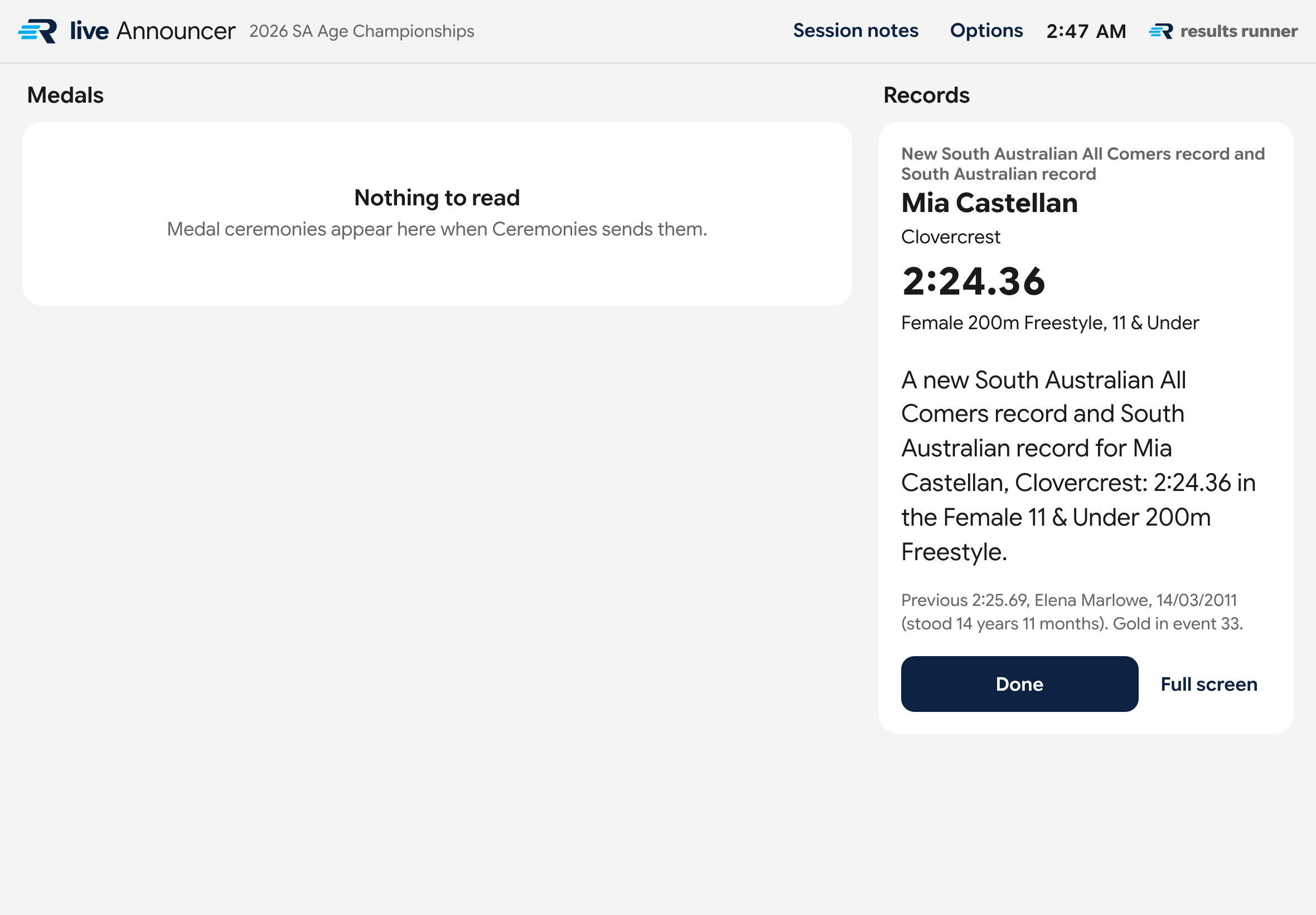
results runner doesn't time races or change results. It reads what the meet has officially posted.
Meets in South Australia are run on Hy-Tek Meet Manager, which posts each event to a live results page once it's finalised. results runner runs on the records desk computer and reads those pages every few minutes during a session, fetching only the events that have changed. After each check it sends the changes to Results Runner Live.
For meets SwimmingSA runs, it also reads the meet's entry file, which has full names, clubs and dates of birth. It needs those because:
- Live results pages cut long names short. The entry file has the whole name.
- Records go by a swimmer's age on the day of the swim, which needs a date of birth and the date of the session, not the age group they entered.
For a meet SwimmingSA does not run, such as a national championship, it follows the posted results and checks the South Australians for records.
How a swim is checked
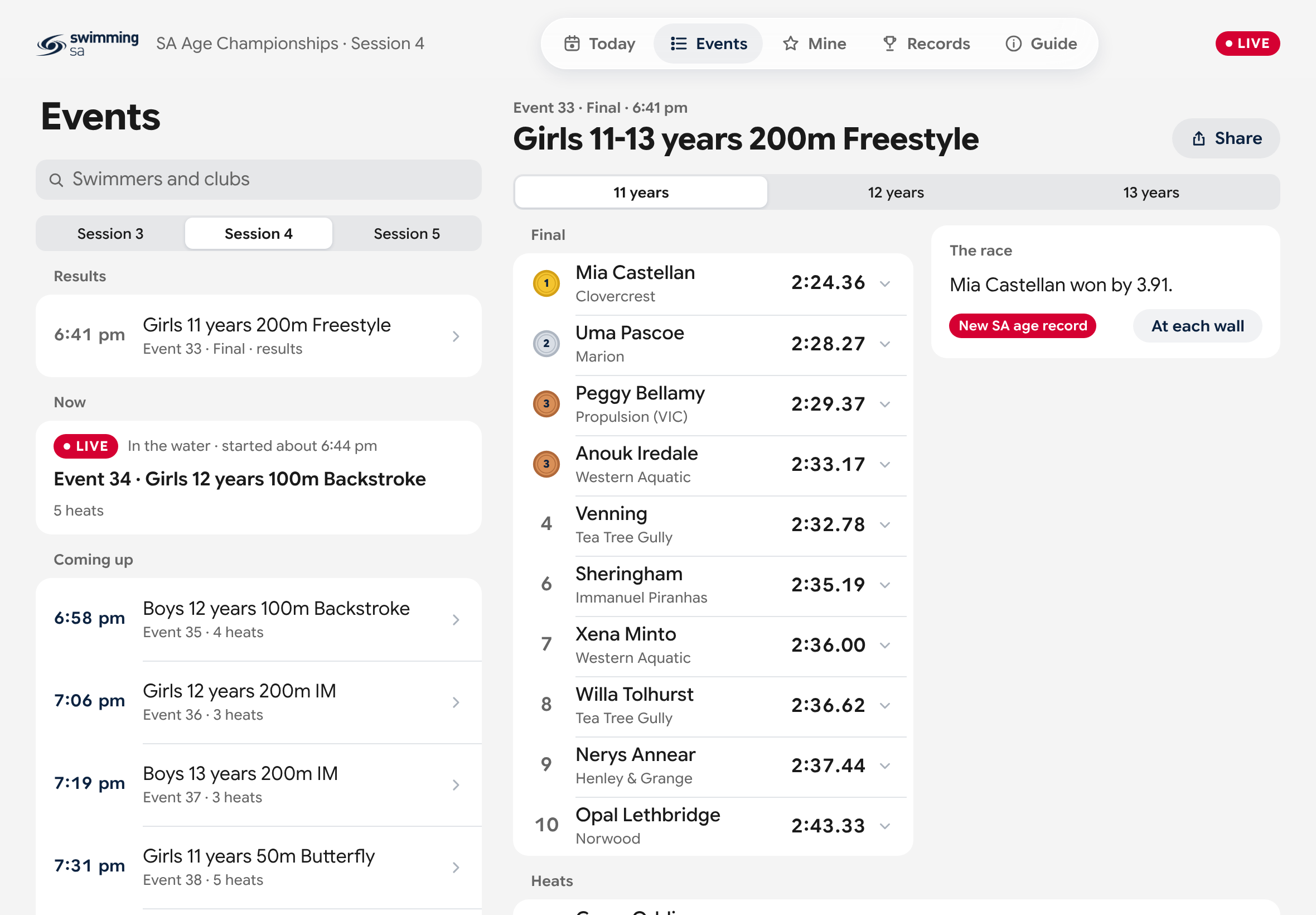
Each swim is compared with every record it could break, using the SwimmingSA Swimming Rules (SW) and Event By-Laws (EBL).
| Check | What it means | Rule |
|---|---|---|
| Age on the day | A swimmer is checked against every record whose age band includes their age on the day of the swim, plus Open. An 11 year old can break the 12 years record. | EBL 23.2 |
| Pool length | Long course records need a 50m pool, short course records a 25m pool. | SW 12.1 |
| A legal swim | Disqualified, scratched, no-show and did-not-finish swims are never considered. | SW 12 |
| Equal times | A time that equals the record is a joint record, and is queued for a decision. | SW 12 |
| Splits inside a race | The 50m split of a 100m swim can be a record, if the swimmer finishes the full distance legally. | SW 12.1.7A |
| Relay lead-off | The first swimmer's leg of a relay counts as an individual swim. Not in mixed relays. | SW 11.6 |
| Relay age groups | A relay is checked against every relay record whose age band holds all four swimmers. | EBL 23.2 |
| Standard times | Some records have a qualifying time and no holder yet. The first swim at or under it becomes the first holder. | EBL 23.1 |
| Time trials and swim-offs | Both can set a record, and both are flagged so the officer knows what kind of swim it was. | SW 12.1.5A |
| Timing | Records need electronic or semi-automatic timing. The officer confirms how the swim was timed. | EBL 23.5 |
| Membership | The swimmer must be a current member when they swim. The officer confirms it. | EBL 23.3 |
A swim can break several records at once, for example a state record and an allcomers record in two age groups. They're listed on one card and decided together.
Why a person decides
results runner flags a possible record. A records officer decides whether it stands.
Some things aren't on a results page: whether the swimmer's membership is current, how the race was timed, why a swim was marked exhibition, or whether a multi-class classification is confirmed. The officer checks those before ratifying, and the card lists which ones are still outstanding.
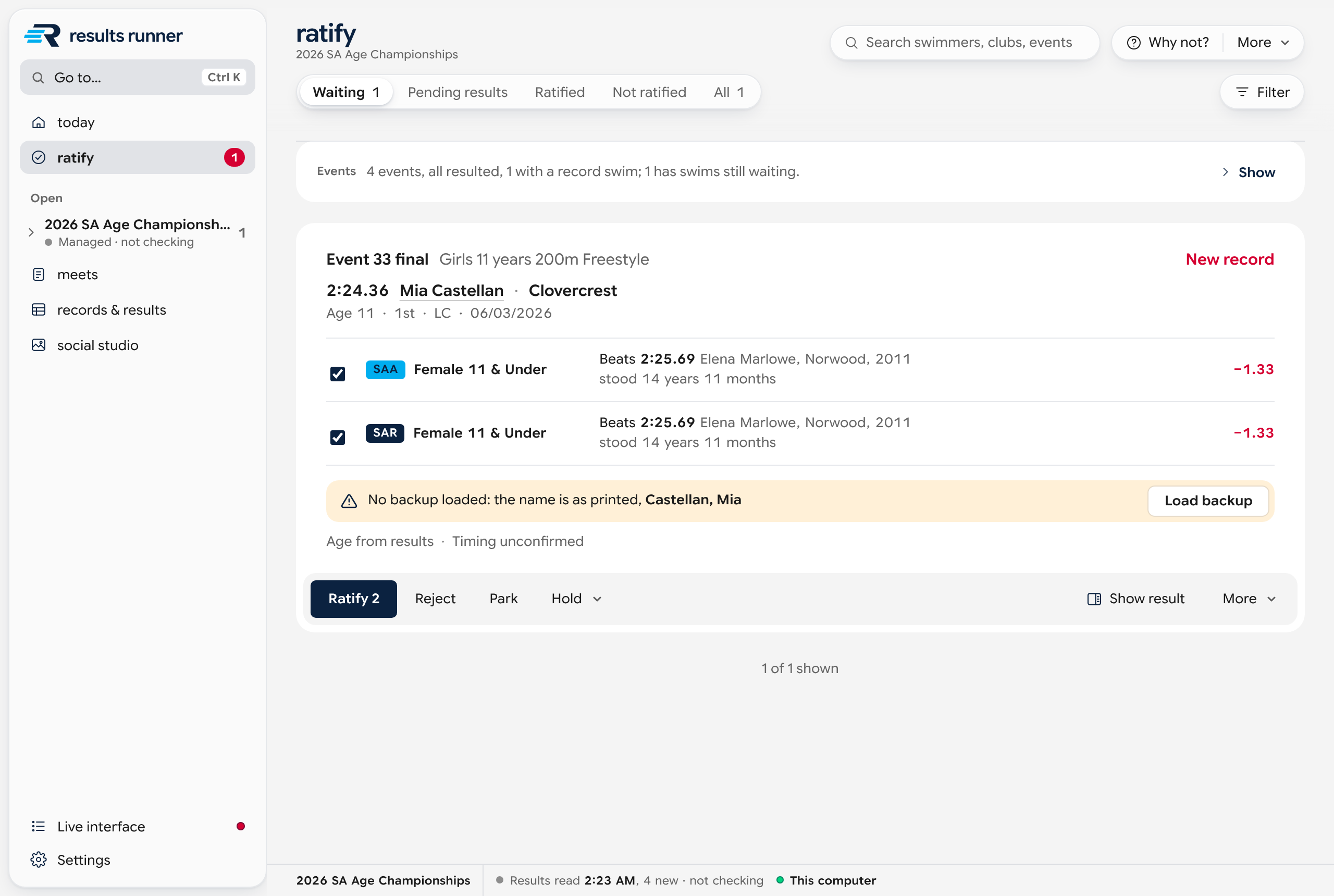
The officer sees the line from the official results, the swimmer's entry and the current record next to each other. There's also a rule-by-rule explanation of why a swim qualifies, and one for any swim that didn't, which is useful when someone asks why a swim wasn't a record.
Safeguards
- Records are ratified in the order they were swum. A later swim cannot be confirmed while an earlier one at the same record is still open.
- A swim 3% or more faster than the swimmer's previous best is flagged as a big drop. Most of the time it's just a very good swim, but occasionally it's a timing fault.
- A record that is older than the swimmer who broke it is pointed out.
- Any decision can be undone, and each record keeps a history of its previous holders.
A record stays at the desk until it's ratified. Results Runner Live doesn't show it before then.
Rankings and percentages
The rankings are worked out at the desk from every result results runner has read. Nobody keeps them as a separate list.
- Age is the swimmer's age on the day of the swim, the same way the record rules count it.
- Club is the club they swam for at the time, so a swim stays with that club if the swimmer later moves.
- Seasons follow the trophies: short course is the calendar year, long course runs October to September.
- Heats, finals and relay lead-off legs all count. Splits inside a race do not.
Record percentage
Each swim is shown as a percentage of the state record: the record time multiplied by 100 and divided by the swim time, both in seconds (EBL 22.15). It lets a 50m sprint be compared with a 1500m, and several perpetual trophies are decided on it. Drag the slider to try it.
2.58 outside the record.
Pointscores
Club pointscores use the points the meet awards: 10 down to 1 for individual finals and 20 down to 2 for relays (EBL 22.1). results runner adds them up as each final is posted and cross-checks its totals against the team scores the meet publishes.
What happens to the data
Results Runner Live shows the same things a meet's official results show: names, ages, clubs, times and places.
- Dates of birth and registration numbers are never sent to the site. A date of birth is used at the desk to work out a swimmer's age on the day, and stays there.
- The reason for a disqualification is not shown. The result carries the code only.
- SwimmingSA can withhold a swimmer's name. The swim and the time stay, so the places still add up, and search does not find them.
- The swimmers you follow are saved on your own phone. There's no account, so the site doesn't hold anything about you.
- Every results page asks search engines not to index it.
- Only the records desk computer can send results to the site, and it never writes to the official results. If a result is corrected at the meet, the correction comes through on the next check.
How it is tested
Each release is run against real meet files before it's used at a pool.
The automated checks are built from actual meet files, including full championships, club carnivals, relays and multi-class events. A change that breaks one of them doesn't get released. Releases are small and frequent, and SwimmingSA approves each one.
If a result or a record looks wrong, tell the records desk at the meet or contact SwimmingSA.